
Corny
Canadian duck
Finally – something different for breakfast! The Canadians are here so I have to do a real English breakfast with bacon, sausages, scrambled eggs, mushrooms, black pudding, baked beans and toast – brilliant!
Then off to Cambridge and Immie’s skating party. It’s unnatural for english people to ice-skate. We simply have no grace and it’s all too obvious when we strap blades to our feet and try to look like we know what we’re doing. And that lack of grace is compounded by the fact that we can’t maintain ice rinks either – it feels more like skating along a rocky mountain pass than a placid lake. Why can’t we do these things properly?
Anyway – we get back and it’s time to cook the thing I have been waiting to do ever since I started this blog –
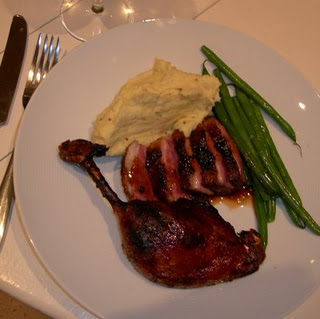
Confit of duck leg, pan fried duck breast with mustard mash and garlic fine beans
The thing to know about this meal is that you should prepare the confit at least a day before you eat it (although you don’t have to).

For four people you need a whole duck and an extra pair of legs. Take the duck and remove the legs and the breasts. Remove any fatty skin from the bird cut into small chunks and put in a saucepan. Trim the excess fat off legs and breasts (not too closely) and put the fat into the pan, then put the pan on a low heat. When the fat has fully melted you can take the pan off the heat and set aside. In the meantime, take the legs and cover them in salt (and pounded juniper berries if you have any) and leave for a few hours (or overnight if you’re patient – although to be honest – you can probably skip this step if you are in a rush)
When that’s done – take the legs and scrape off the excess salt and juniper berries and put them in an oven proof dish (that is just big enough for all four legs) and pour over the duck fat – they should be virtually covered in the fat. Cover with foil and put in a low oven (about 150c) for two hours then just turn off the heat and leave them. You can turn them over half way through cooking if you like. The trick is to make sure they cook in the fat and that they don’t cook too quickly. Once they are cool, that’s it – they can stay in the fat for a very long time (old French preserving technique).
Right – now you’re ready to cook the meal –
I think I’ve done mashed potato before so just look down this blog – the key here is to make sure there is a enough cream, mustard, salt and pepper in there.
Take the legs – scrape off the excess fat, place on a baking tray, brush with a little honey and place in the oven at 180c. They will take about 20 mins – but check them to make sure they don’t overcook. Take the duck breasts, season well and place into a frying pan at a moderate heat (about 3/4 strength) fat side down. Now the timing completely depends on the thickness of the breasts but I would go for about 5 mins on the fat side, turn over for 4 mins, and then do a last couple of mins on the fat side again. The breast needs to give when you prod it – otherwise it’s overcooked – and that is a disaster. When done, take them out of the pan and onto some foil to rest. While the duck is frying, steam the fine beans for about 5 mins until almost cooked. Then take the beans out of the pan, finely chop a large clove of garlic and put it in the pan with a good shot of olive oil for one minute, then put the beans back into the pan with lots of salt and pepper – they will be the best beans you have ever tasted – trust me.
Finally, put equal amounts of honey and balsamic vinegar into the pan and let it reduce a little to make a glaze. Now you just need to serve –
Cut the duck breasts into 1 cm slices and place on the plate, covering with the glaze. then add the leg, mash and beans. Works every time.
Lovely with Rioja.
Fishcakes, but not fried off
It starts with Saturday kitchen and I finally realise what it is that I hate about TV cooks – they always have to add a spurious word at the end of everything they say – so “fry it” becomes “fry it off”, “trim it” becomes “trim it up” – the list goes on – “brown it off, “whisk it up”, “boil it down”. And they all seem to do it. Infuriating.
The days starts with – need I say it – croissants and pain au chocolat – I have to find something different next week. Then simple spaghetti with ragu sauce for lunch. But supper is a little more interesting –
Trout and Smoked Salmon Fishcakes
Peel a handful of potatoes and place them in salted boiling water. Take a couple of trout fillets and very gently fry them in a pan with butter – not cooking them fully through.
When the potatoes are cooked, mash them with butter, double cream salt and pepper, then take the skin off the trout and flake it into the potato mixture. Finally, pull the smoked salmon into little pieces and add.
Finely chop a handful of dill and mix it all together, checking that the mixture is well seasoned. If it is a little too wet, add a handful or two of breadcrunbs.
Now form the mixture into individual cakes, no more than about 1 cm thick and 3-4 cms in diameter. Fry them in butter and serve with a green salad.
Brilliant with a bottle of Australian Riesling (Tim Adams is a good one)
Oscar’s Birthday
Oscar’s Birthday!
Three hours trying to amuse 17 eight years olds in a sports hall with a football, a basketball and a bouncy castle – it is a fact that they get more frightening as every year passes. And not one of the little buggers ate my sandwiches
I’m on my own tonight and I decided to try something different –
Beef fillet with pureed cauliflower and parsnip chips (for two)
Take half a cauliflower and cut it into small florets then heat in a saucepan heated with a good knob of butter (and with the lid on). After 5 minutes add a good glug of white wine and leave it to cook in the wine for a further 5 minutes. In the meantime peel a few parsnips, cut in half lengthways and cut into thin chips, then put them in a deep pan of sunflower oil for 5 minutes (hot but not too hot). Take them out and turn up the heat to get the oil really hot (but not smoking). In the meantime add some cream and dijon mustard to the cauliflower and use a hand blender to puree the mixture. finally add tarragon and season with salt and pepper.
Now put the beef fillets into a very hot frying pan (after seasoning and rubbing with olive oil). After a few minutes turn over and put the parsnip chips back into the (now) hot oil.
As soon as the parsnips start to turn brown, bring them out of the pan and onto some kitchen roll, then season. Take the fillets out of the frying pan when ready (for perfectly rare you just need a few mins on each side) and leave to rest.
Now put the cauliflower puree on the plates with the fillets on top (probably best sliced into three or four pieces and hopefully beautifully red inside) and the chips on the side – lovely. Personally I think the more mustard you use the better….
And then back to the X factor – finally Daniel goes – fingers crossed for Rachel to go next week… How is it that either of these people managed to stay on the show for so long – they are hopeless, simple as that…
Sunday lunch
More crossants and pain au chocolat – I really have to get them to try something different for breakfast. I’m not worried though because it’s merely a prelude to the main event – Sunday Lunch…
Roast chicken with mashed garlic swede, cabbage, roast spuds and parsnips
Firstly prepare the chicken by stuffing with half an onion a handful of rosemary and thyme and a stick of celery, then slash the thighs and cover the whole thing with lots of salt, pepper, tarragon and olive oil. put it in a 220c oven – it needs to stay in there for about an hour and twenty minutes then pull it out out and rest it in foil while you make the gravy with the juices from the bottom of the pan, some flour, a glug of wine and the water that you used to cook the veg.
A few things to mention about the veg (although I’m not going to take you through it step by step – this isn’t a cookery book). To get perfect results you must par-boild the spuds (10 mins) and parsnips (5 mins) before you put them in the oven (this time I used extra virgin rapeseed oil – bright yellow and beautiful) for about 40 mins.
The cabbage should also be cooked in boiling water for a just a few minutes before dropping into cold water and leaving until ready to reheat in a pan with butter and lots of seasoning. The swede just needs to be cut into chunks and boiled in the water you used from the spuds. When the swede is cooked, take it out of the pan, and drop in a good chunk of butter with a couple of cloves of garlic finely chopped. Then put it back into the pan and mash – perfect…
Of course – all of this is for nothing without a big bowl of bread sauce – milk heated to simmering point with an onion and a few cloves, left to cool a little then strained into another saucepan. Add a few handfuls of breadcrumbs, lots of butter, a few glugs of cream and season…
Very simple but loads of work and loads of washing up. It’s well worth it though – especially for the chicken sandwiches later that evening. And DON’T forget to keep the carcass – put it in a saucepan with an onion, a few peppercorns and a carrot, then add boiling water and simmer for about forty minutes – perfect chicken stock and none of those rubbish stock cubes in sight.
Lunch is over and the weekend is drawing to a close – just enough time for a quick outing on the bikes and more wii (although no more wii sports which was an unfortunate casualty of the weekend – left on the floor and scratched to death by a careless short…)
Bruschetta and the shorts